Wednesday, June 15, 2011

Saucy Seniors

It's a Peace Corps tradition to put together a "yearbook" for the outgoing "seniors," and I'm a senior, baby! Much like anxious 17 year olds suffering from a severe case of senioritis,  my friends and I have spent the last few weeks bandying about our "senior quotes" and "senior superlatives" over rambling phone conversations and extended weekend getaways. As with any graduation, I'm feeling a bittersweet sense of nostalgia. As I keep telling my friends, I'm ready to look back on this experience fondly. I am undoubtedly ready to move on and start the next great chapter of my life, but I am equally sure that there is a great deal I will miss about Peru, Peruvians, and this crazy Peace Corps lifestyle. I'm sharing an excerpt of my COS profile (COS = close of service) with you in an attempt to summarize some of these feelings.

Description of your service in 100 words or less:
Jessica spent two years trying, unsuccessfully, to learn the names of all 723 other inhabitants of Huaca Rajada, playing hours of Uno and hide-‘n-seek with neighborhood kids, and gossiping around the kitchen table with her host family. In her spare time she helped develop a new product line for the costura association, gave general marketing and accounting talleres, helped construct a cockfighting ring, and taught some English. She is an unapologetic fan of drinking circles and campo bailes, where she is heads above the rest on the dance floor. All in all, it was a weirder and funnier two years than she ever could have imagined.

Was it worth it?
Without a doubt. For all the long and boring days at site, there are just as many hilarious and fun memories. I’ve learned more about myself, and the world, than I ever imagined possible.

Favorite peruano en tu sitio:
My host family for teaching me the true definition of generosity. Special shout out to my chanchito nephew, Bryan, for always finishing my leftovers and for letting me play hours of Super Mario Bros with him.

What do people in your site consider your strangest behavior?
Sleeping with a fan every night, exercising, and drinking cold water. Frankly, even I am surprised to still be alive.

What's the longest amount of time you spent in site?
15 long and sweaty days.

TV/Movie character who kept you company in site:
Josh, CJ, Toby, and Sam were the best friends a girl could ask for.

Worst movie you’ve watched on a bus:
I once watched three Hillary Duff movies in a row. You say worst, I say awesome!

Longest you've gone without bathing:
5 or 6 days, which is a little excessive considering I have my own bathroom (sans agua) and live in the very hot desert.

Arroz y papas. A necessity or a burden?
Rice is only good for soaking up oil or masking the taste of unidentifiable meat. I will gladly eat 5 kilos of potatoes if it means I never have to eat yucca again.


Weirdest medical issue:
That would have to be the heretofore unknown mango allergy, which resulted in eyes swollen shut, face expanded to three times its normal size, and an unpleasant stint in a Peruvian ER.

Thoughts on cumbia/huayno:
I used to be annoyed by the sameness of every cumbia song, but like many other things in this country, it snuck up on me and I now find myself requesting cumbia songs at parties and adding Grupo 5 songs to my running playlist.

How many cell phones/bank cards/hats/sunglasses/cameras/girlfriends/boyfriends have you gone through? 
4/2/1/15/2/and depends who you ask.

Did you pick up any new hobbies or activities?
Sweeping, Nokia Snake game, and watching entire television series I’d never heard of before from start to finish.


Favorite wall décor in your host family’s house:
The Avon poster with Reese Witherspoon and Patrick Dempsey. They kept me company during many an unpalatable meal.

Combi story:
I was coming back to site on the Sunday of the presidential elections and the car was more crowded than I’d ever seen before, which is saying a lot. I spent the better part of two hours with one baby on my lap, another awkwardly sprawled on my shoulders/head, and a woman’s lady parts melded to my left arm. I quite literally couldn’t move a muscle. Oh, and the woman sitting next to me had propped her broken ankle across my legs, effectively pinning me to the seat. Did I mention it was 9,000 degrees?

Most amusing misconception you have heard about the U.S.?
Everyone is rich and drives two cars. We eat everything, especially meat, out of cans.

Have you been robbed?  What did they take?
Peru robbed me of my dignity, modesty, and any sense of shame very early on.

What’s the most creative thing a Peruvian has said to you in English?
“I love you but I don’t know what to do about it.”

Best/weirdest gift from a Peruvian:
On my second day in site, my host brother gave me a framed picture of his recently deceased grandmother. In her coffin.

Most embarrassing story:
As I said, I lost any sense of shame early on and, as a result, don’t realize many of the ways in which I embarrass myself daily. But this one still stands out: I had come back from an afternoon run and was playing tag with some kids outside my room. After about 15 minutes, I reached into my running shorts to get my key, but I couldn’t find it. I jumped around a little and felt the key move. After a couple awkward minutes groping around, I realized the key had somehow worked its way into the lining of my underwear. There was no way to get it without pulling down my pants. I tried to get the kids to walk away but they refused to leave my side. So I walked around a corner and discreetly pulled down my shorts only to look up and see several concerned parents starting at me. One hand in my underwear, five kids around me, and a terrified look on my face. Awkward.


Biggest lie that you’ve told:
To my host family: “I’ll be back tomorrow.”

Meltdown story:
Toss-up between the hospital stint and the 18-hour canoe ride. Or all those times my community completely bailed on my meetings and/or projects … but I kind of got used to that after about a year.

How has Peace Corps changed your future plans?
It’s actually made me less certain of what I want to do or where I want to be – after this anything seems possible.

What Peruvian article of clothing or accessory are you planning to rock when you return stateside?
Graphic tees are the new black.

What will you be sad to leave behind?
My host family. The unwavering generosity of Pervuians and their amazing ability to feed however many people show up with whatever is in the pot. The rambling conversations. The freedom to do whatever and be whomever I want. The serenity of campo life. Huancaina sauce, tacu tacu, and ceviche.

What will you not be sad to leave behind?
The complacency and machismo. Not fitting on combis, collectivos, taxis, or buses. Public urination. The way drunk campo men smell.

What has Peru taught you?
Not to take myself too seriously. To go with the flow. To find beauty in the most unexpected places.

What scares you the most about returning to the States?
The 2012 election.

First meal you will have when you get back to the States:
Chips con queso, chicken enchiladas with sour cream and guacamole, veggie fajitas and ice cold beer out of a can. My stomach is growling as I type.

Any advice for current/future PCVs?
Don’t take anything, especially yourself, too seriously. Sure there are down moments and times you want to kill your host family, counterpart, etc., but being able to laugh at your situation is the only way to stay sane. And, c’mon, it’s funny.

And my superlative? "Most likely to bring Papy." :-)

Friday, May 27, 2011

Sipan Stories

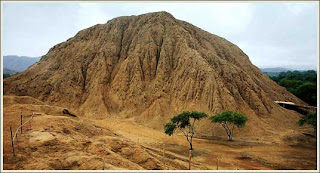
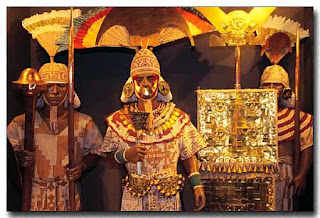
As I’ve mentioned before, my site is home to some ancient Moche ruins – a civilization which pre-dates the Incas by nearly 1,000 years. The ruins are most famous for the 1987 discovery of the Señor de Sipán, an incredibly well-preserved tomb of a warrior king. Many of the artifacts from this tomb, and others more recently discovered, are on display at our local site museum, a state-run facility.

The story of the discovery and excavation of the tomb is a popular one around these parts. There is the version that exists in the “official” history of the region, and there are the versions that are passed from family to family. As you can imagine, the official history lacks some of the local color and flair I’ve come to expect from my Peruvian neighbors. I’ve been here long enough to listen with a heavy dose of skepticism, but after nearly two years piecing together the disparate bits, doing a little of my own research, and brushing up on archaeological vocabulary, I’m ready to take the story public.

Get ready – it’s a fascinating yarn of mystery, the supernatural, history, and international intrigue. And also one that’s surprisingly heartbreaking.

Seriously.

The Moches were dominant from around 100 AD to 800 AD, an impressive reign by all accounts. The surviving pyramids (the huacas for which my town is named) don’t look like much; they’re large, misshapen dirt mounds. Before the archaeologists descended, local residents didn’t know, or didn’t care, that they were valuable relics from the past. In the time of Spanish colonization, homesteads were built directly on the huacas. Weather, time and human destruction have taken their toll.

Local legend claims spirits still haunt the area. I’ve heard a number of people tell me about times they were walking by the tomb at night and heard strange whistling noises. One of the night guards swears he saw something glowing above an excavation site. The dogs, which supposedly have a sixth sense about these things, won’t go near the tombs on a full moon.

Beginning in the early 1980s, local residents began finding little gold statues or ceramics in the fields around the huacas. My host mom loves to tell a story of her kids bringing home huge hunks of turquoise they found in the mud after a particularly hard rainstorm. Every local family has stories of treasures found and lost again.

In the mid-1980s the Bernales family claims to have received a divine message directing them to the source of all these riches. Mr. Bernales, who coincidentally is a distant cousin of Papy’s family, told his friends and family that he’d dreamt of four donkeys pulling carts of gold from the mounds. He is said to have pressured Papy’s father to go on a late-night raid with him. Papy’s papy declined and the secret raid went ahead without him. The Bernales family racked up some serious loot, and they weren’t shy about telling people: supposedly their windowsills were decorated with gold statues. A local bigwig got wind of the fortune and alerted the authorities. According to my host family, a few months later, police stormed the Bernales residence, severely beat Mr. Bernales, and sacked all the loot. Mr. Bernales died in the car on the way to Chiclayo.

Shortly thereafter, in the spring of 1987, archaeologist Walter Alva discovered the warrior tomb, directly below where Bernales and friends first hit it big. The artifacts were hauled down in donkey-pulled carts. To this day, long-time residents of Huaca Rajada and Sipán scoff at Alva’s name, not believing he deserves the credit and fame for the discovery that cost one of their own his life.

The relationship between the town and the archaeologists was doomed from the start. Archaeological journals and history books mention little of the role played by the local excavators, to say nothing of the Bernales family saga. In the months following the initial discovery, huaceros (loosely translated as ‘grave robbers’) descended on the site, pillaging hundreds of priceless artifacts for sale on the black market. International investigators, including the FBI and Interpol, were called to the scene. Artifacts were found as far away as Philadelphia. A large majority of the pieces were recovered, but some remain lost to this day.

It’s unfortunate to lose such valuable relics, and with them a window into the past. But what is perhaps more tragic is the daily reminder to the people of Sipán and Huaca Rajada of the narrow window of their future.

In the wake of the 1987 discovery Sipán landed on the international archaeology scene. And with the subsequent discoveries and the construction of the new site museum, there was a hope that the community could at long last capitalize on its rich history.

Unfortunately, the increasing numbers of tourists and high-profile visitors do little to change the economic realities in these towns. The museum employs very few local workers, choosing instead to bus in “experts” from Chiclayo, Trujillo or Lima. The excavation site is only open for part of the year, and the additional workers hired earn a pittance for their manual labor. None of the proceeds from the ticket sales are invested back into the town.

This certainly does not mean that there aren’t opportunities for improving relationships between the museum and the community. There are. I’ve been trying to facilitate those meetings for two years. But the river of mistrust runs deep around here. Damn the man!

Editor’s Note: I am not an expert on this issue, and it’s more complicated than one blog entry can tackle, but I do feel confident in expressing my opinion as someone who has lived here, among the people, every day for the past 22 months.

Monday, May 16, 2011

Like Lists

My volunteer friends and I jokingly like to put together lists poking fun at Peruvians, a tongue-in-cheek way to let out some steam. I’m not going to publish “Things Peruvians Like” or its companion list, “Things Peruvians Are Scared Of” here because without understanding the context or the spirit of the lists, they seem a little harsh. We laugh because we love.

Instead, I've decided to share with you another list I've been working on:

Reasons I Like Peruvians:

  • Their unwavering generosity;
  • That no matter how many unexpected guests turn up at the dinner table, there’s somehow always enough food to go around;
  • The women have a surprisingly raunchy sense of humor;
  • They love to dance and do so completely unselfconsciously;
  • They will tell you their life story immediately upon meeting you, which might be heartbreaking or heartwarming, but is always honest;
  • Their lack of body image issues;
  • And hand-in-hand with that, their rich culinary traditions;
  • They love to throw a good party or tell a good story;
  • That despite all the hardships they endure, they love to laugh – at themselves, at each other, at their country – and their humor is infectious;
  • Because they welcome me into their homes as a friend, a sister, a daughter.
Some of my favorite relatives showing off their hospitality (and adorableness).

To me, Peru is like that kooky friend or aunt or cousin we all have. The one we roll our eyes at and laugh a little about, but who we secretly, passionately hope never changes because we love her for being exactly who she is with no apologies, and because when you break through the surface barriers and see the essence of the person (or place), it’s startlingly beautiful.

Peruvians: always a good time.