Showing posts with label peace corps. Show all posts

Wednesday, July 13, 2011

Road Rage

I have never willingly put myself through such constant physical discomfort as I have by braving the cars, vans, and buses in Peru. I think by now you all understand that I am much, much taller than my Peruvian counterparts. My legs are literally twice as long as some of the women I know here. It’s silly that I even try to fit into Peruvian-sized spaces, but when the alternative is staying in Huaca Rajada indefinitely, you better believe I’ll squeeze myself into the first thing with wheels that’s headed west.

 Terminal Epsel, Chiclayo: organized chaos.

Taxis are ubiquitous in all Peruvian cities. In Chiclayo, both mototaxis and ticos are popular and cheap ways to get around. A mototaxi is a similar to a rickshaw but with a small motorcycle for power, usually steered by a 15-year-old boy. As with all things wheeled here, there are varying degrees of luxury and age. Roads are rough and bikes and cars take a beating. Shocks are pretty much non-existent and we ride low to the ground, which can make for a bone-jarring ride on the best of days. Especially when you’re loaded down with gallons of water, boxes of wine and stacks of books to take back to site.

Ticos are mini-taxis most often seen in northern coastal cities. They’re like a miniature version of a Mini Cooper but a whole lot jankier. I would say they comfortably seat about half a person, but we routinely squeeze four gringo-sized people in there. Anything to save a few centimos (that we then go spend on overpriced and underwhelming pizza). I have ridden with six full-sized adults before, plus the driver. It’s like the circus – how many clowns (Peace Corps volunteers) can we fit in one tiny car?

Looking frightened on one of my first Lima combi rides.

Combis are beat up minivans that run circuitous routes around the cities or shuttle people between the capital city (Chiclayo, for example) and a campo town. Rides can cost anywhere from 50 centimos to 4 soles (one good thing about public transport: it is cheap). The best seat in the front passenger seat but then you have an up close and personal view of the many, many times you almost die in a head-on collision. A combi can comfortably seat eight people but they routinely squeeze up to 15 adults, a slew of nursing babies, and bulging bags of produce and/or livestock. I once rode for two hours with a pig strapped to the roof. That pig seemed to enjoy his trip about as much as I did (side note for all you non-farm dwellers, pigs are extremely loud. Like louder than you’d ever imagine.).

How many Peruvians does it take to change a tire?

Coosters are what I’ve spent a large percentage of my time on these last two years. A cooster is a larger version of a combi, sort of like a public school bus in the States, but much older, more beat up, and all-around horrible. The average trip from Huaca Rajada to Chiclayo takes about an hour-and-a-half, but this can vary depending on a number of factors: road conditions, the driver, passenger weight and cargo, number of stops, flat tires, etc. The best ride I ever had took just under an hour and the worst was upwards of three hours. There’s an art to riding coosters that I’ve finally perfected.

Fun with Peruvians on moving vehicles.

Not even visiting siblings are immune to the joy(e)s of public transportation.

As a tall lady, I initially sought out the aisle seats so as to provide myself with a little extra leg room. This is correct in theory, but as the cars inevitably fill up and all manner of Peruvians squeeze themselves into the aisles, your extra leg room is quickly overtaken by muffin tops, squealing babies, and unsteady drunks. There is no such thing as personal space on a crowded trip. I’ve become intimately acquainted with more strangers than I’d like to recall. No, the best seat is a window seat in the first or second row. The back seats take the brunt of the potholes and it’s nearly impossible to disembark from the back row (picture the gangly gringa literally climbing over seats knocking unsuspecting grandmothers upside the head with giant bottles of water). I wish the pictures I had did better justice to my stories, but the best/worst rides are far too crowded to even think about getting out a camera and snapping a pic. Just trust me when I say it’s a painfully hilarious experience.

Please note the difference between the length of my leg and the back of the seat.

Long-distance buses range from the awful to the luxurious. I once took a 14-hour trip to Lima on a directo bus (i.e. economic) with Papy’s head on my shoulder and my seat unable to recline. That was pretty bad. But on the whole, overnight buses are pretty comfy, especially after two years of practice.  I just bought my LAST BUS TICKET EVER and went for the nicest of the nice – a 180 degree reclining leather seat. I’m giddy.

My typical Peace Corps experience: waiting for a car to anywhere.

I started out this blog post intending to convey how much I hate public transportation, but writing and remembering some of my favorite stories, well, it all seems kind of funny and endearing now. I’m sure this also has something to do with the fact that I have only about two trips left. Hindsight is a funny thing. 

Tuesday, June 28, 2011

Back to Basics

I’ve spent a lot of time and space chronicling the amusing oddities of life in Peru on this blog. Recently feeling reflective, I skimmed over some previous blog entries, and it was both horrifying and enlightening to see how my writing (which I suppose is an extension of me…hey, cool, I’m “evolved”…) has evolved over the last two years. Reading early entries I'm struck at my own naiveté, my confusion, my awe. I thought everything was so strange, so funny. About a year or so in, I started to become a little more analytical; no longer confounded by drinking circle etiquette I focused more on the differences between here and there, between us and them, and realized that maybe things weren’t so different after all. And then all the things that had delighted and confused me in those early months started to annoy me in their repetitiveness and predictability. I was desperate for escape and set my sights further afield.

And now?

In my own banal predictability, I’ve come full circle and am again charmed by this place, by these people. The little things that became invisible in their familiarity are now blindingly apparent. Like the smell of the adobe stove that clings to your clothes after lunch, the spicy-acidic taste of fresh ceviche, the gurgling sounds the faucet makes every morning around 11 when the water turns on, the thwacks of the soccer ball outside my open window.  I am trying desperately to commit to memory these images, smells, tastes, and sounds. Trying to linger a little bit longer in my daily routines absorbing what makes them so familiar and, at the same time, soon-to-be so foreign.

I know I’ll never forget this experience, but I also know that these comforting sensations will someday soon be relegated to far reaches of my memory. I’ve started carrying my camera with me everywhere, taking random pictures of dirt paths and doorways because I know one day I’ll forget the way the sun reflects off the tempered glass of my neighbor’s window every afternoon.  Even my daily runs through swaying sugarcane fields seem profound from this perspective of almost-hindsight. Will something that has been such a part of my daily existence be easily forgotten?

And the people. Argh. The people. How do you say goodbye, most likely forever, to the people who have been the one constant in your rollercoaster emotions? Their laughter and conversation sustained me on days when there was little else keeping me here. How do you thank someone for literally keeping you sane? I can only hope to carry a little of my host mom’s sly wit and boundless capacity for mothering with me, to sear the sound of Bryan’s high-pitched giggle to my heart, to hold onto the optimism and generosity that so many people have shown me over countless lunches and lazy afternoons. Sitting beneath my open window on a typical afternoon, I can look up from my book and identify the neighborhood kids by the tones of their shrieks, the chords of their laughter. Will the new soundtrack of my life ever hold this much innocence, this much promise? I doubt it.

It’s becoming all too real, friends. Goodbyes suck. 

Wednesday, June 15, 2011

Saucy Seniors

It's a Peace Corps tradition to put together a "yearbook" for the outgoing "seniors," and I'm a senior, baby! Much like anxious 17 year olds suffering from a severe case of senioritis,  my friends and I have spent the last few weeks bandying about our "senior quotes" and "senior superlatives" over rambling phone conversations and extended weekend getaways. As with any graduation, I'm feeling a bittersweet sense of nostalgia. As I keep telling my friends, I'm ready to look back on this experience fondly. I am undoubtedly ready to move on and start the next great chapter of my life, but I am equally sure that there is a great deal I will miss about Peru, Peruvians, and this crazy Peace Corps lifestyle. I'm sharing an excerpt of my COS profile (COS = close of service) with you in an attempt to summarize some of these feelings.

Description of your service in 100 words or less:
Jessica spent two years trying, unsuccessfully, to learn the names of all 723 other inhabitants of Huaca Rajada, playing hours of Uno and hide-‘n-seek with neighborhood kids, and gossiping around the kitchen table with her host family. In her spare time she helped develop a new product line for the costura association, gave general marketing and accounting talleres, helped construct a cockfighting ring, and taught some English. She is an unapologetic fan of drinking circles and campo bailes, where she is heads above the rest on the dance floor. All in all, it was a weirder and funnier two years than she ever could have imagined.

Was it worth it?
Without a doubt. For all the long and boring days at site, there are just as many hilarious and fun memories. I’ve learned more about myself, and the world, than I ever imagined possible.

Favorite peruano en tu sitio:
My host family for teaching me the true definition of generosity. Special shout out to my chanchito nephew, Bryan, for always finishing my leftovers and for letting me play hours of Super Mario Bros with him.

What do people in your site consider your strangest behavior?
Sleeping with a fan every night, exercising, and drinking cold water. Frankly, even I am surprised to still be alive.

What's the longest amount of time you spent in site?
15 long and sweaty days.

TV/Movie character who kept you company in site:
Josh, CJ, Toby, and Sam were the best friends a girl could ask for.

Worst movie you’ve watched on a bus:
I once watched three Hillary Duff movies in a row. You say worst, I say awesome!

Longest you've gone without bathing:
5 or 6 days, which is a little excessive considering I have my own bathroom (sans agua) and live in the very hot desert.

Arroz y papas. A necessity or a burden?
Rice is only good for soaking up oil or masking the taste of unidentifiable meat. I will gladly eat 5 kilos of potatoes if it means I never have to eat yucca again.


Weirdest medical issue:
That would have to be the heretofore unknown mango allergy, which resulted in eyes swollen shut, face expanded to three times its normal size, and an unpleasant stint in a Peruvian ER.

Thoughts on cumbia/huayno:
I used to be annoyed by the sameness of every cumbia song, but like many other things in this country, it snuck up on me and I now find myself requesting cumbia songs at parties and adding Grupo 5 songs to my running playlist.

How many cell phones/bank cards/hats/sunglasses/cameras/girlfriends/boyfriends have you gone through? 
4/2/1/15/2/and depends who you ask.

Did you pick up any new hobbies or activities?
Sweeping, Nokia Snake game, and watching entire television series I’d never heard of before from start to finish.


Favorite wall décor in your host family’s house:
The Avon poster with Reese Witherspoon and Patrick Dempsey. They kept me company during many an unpalatable meal.

Combi story:
I was coming back to site on the Sunday of the presidential elections and the car was more crowded than I’d ever seen before, which is saying a lot. I spent the better part of two hours with one baby on my lap, another awkwardly sprawled on my shoulders/head, and a woman’s lady parts melded to my left arm. I quite literally couldn’t move a muscle. Oh, and the woman sitting next to me had propped her broken ankle across my legs, effectively pinning me to the seat. Did I mention it was 9,000 degrees?

Most amusing misconception you have heard about the U.S.?
Everyone is rich and drives two cars. We eat everything, especially meat, out of cans.

Have you been robbed?  What did they take?
Peru robbed me of my dignity, modesty, and any sense of shame very early on.

What’s the most creative thing a Peruvian has said to you in English?
“I love you but I don’t know what to do about it.”

Best/weirdest gift from a Peruvian:
On my second day in site, my host brother gave me a framed picture of his recently deceased grandmother. In her coffin.

Most embarrassing story:
As I said, I lost any sense of shame early on and, as a result, don’t realize many of the ways in which I embarrass myself daily. But this one still stands out: I had come back from an afternoon run and was playing tag with some kids outside my room. After about 15 minutes, I reached into my running shorts to get my key, but I couldn’t find it. I jumped around a little and felt the key move. After a couple awkward minutes groping around, I realized the key had somehow worked its way into the lining of my underwear. There was no way to get it without pulling down my pants. I tried to get the kids to walk away but they refused to leave my side. So I walked around a corner and discreetly pulled down my shorts only to look up and see several concerned parents starting at me. One hand in my underwear, five kids around me, and a terrified look on my face. Awkward.


Biggest lie that you’ve told:
To my host family: “I’ll be back tomorrow.”

Meltdown story:
Toss-up between the hospital stint and the 18-hour canoe ride. Or all those times my community completely bailed on my meetings and/or projects … but I kind of got used to that after about a year.

How has Peace Corps changed your future plans?
It’s actually made me less certain of what I want to do or where I want to be – after this anything seems possible.

What Peruvian article of clothing or accessory are you planning to rock when you return stateside?
Graphic tees are the new black.

What will you be sad to leave behind?
My host family. The unwavering generosity of Pervuians and their amazing ability to feed however many people show up with whatever is in the pot. The rambling conversations. The freedom to do whatever and be whomever I want. The serenity of campo life. Huancaina sauce, tacu tacu, and ceviche.

What will you not be sad to leave behind?
The complacency and machismo. Not fitting on combis, collectivos, taxis, or buses. Public urination. The way drunk campo men smell.

What has Peru taught you?
Not to take myself too seriously. To go with the flow. To find beauty in the most unexpected places.

What scares you the most about returning to the States?
The 2012 election.

First meal you will have when you get back to the States:
Chips con queso, chicken enchiladas with sour cream and guacamole, veggie fajitas and ice cold beer out of a can. My stomach is growling as I type.

Any advice for current/future PCVs?
Don’t take anything, especially yourself, too seriously. Sure there are down moments and times you want to kill your host family, counterpart, etc., but being able to laugh at your situation is the only way to stay sane. And, c’mon, it’s funny.

And my superlative? "Most likely to bring Papy." :-)

Monday, May 16, 2011

Like Lists

My volunteer friends and I jokingly like to put together lists poking fun at Peruvians, a tongue-in-cheek way to let out some steam. I’m not going to publish “Things Peruvians Like” or its companion list, “Things Peruvians Are Scared Of” here because without understanding the context or the spirit of the lists, they seem a little harsh. We laugh because we love.

Instead, I've decided to share with you another list I've been working on:

Reasons I Like Peruvians:

  • Their unwavering generosity;
  • That no matter how many unexpected guests turn up at the dinner table, there’s somehow always enough food to go around;
  • The women have a surprisingly raunchy sense of humor;
  • They love to dance and do so completely unselfconsciously;
  • They will tell you their life story immediately upon meeting you, which might be heartbreaking or heartwarming, but is always honest;
  • Their lack of body image issues;
  • And hand-in-hand with that, their rich culinary traditions;
  • They love to throw a good party or tell a good story;
  • That despite all the hardships they endure, they love to laugh – at themselves, at each other, at their country – and their humor is infectious;
  • Because they welcome me into their homes as a friend, a sister, a daughter.
Some of my favorite relatives showing off their hospitality (and adorableness).

To me, Peru is like that kooky friend or aunt or cousin we all have. The one we roll our eyes at and laugh a little about, but who we secretly, passionately hope never changes because we love her for being exactly who she is with no apologies, and because when you break through the surface barriers and see the essence of the person (or place), it’s startlingly beautiful.

Peruvians: always a good time.

Friday, May 6, 2011

Bolivian Bonanza

For this year’s Easter break, I headed across the border to Bolivia. I am happy to report it was a much more successful trip than last year’s ill-fated canoe experience. It was a week of superlatives with visits to the world’s highest navigable lake, the world’s highest capital city, and the world’s largest salt flats. And I’d like to add my own superlative as my most favorite vacation to date.

The adventurers.

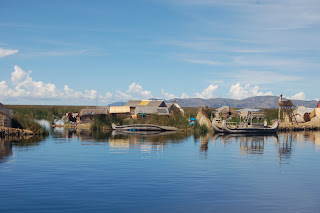
We started the trip in Puno, Peru, visiting the floating islands of Lake Titicaca, which I was excited to see. There are indigenous tribes that live on reed islands in the middle of the lake, eschewing modern technology and preserving a lifestyle that dates back centuries. However, I was a little disappointed. It was so touristy – a 30-minute boat ride to what amounted to a floating artisan market. The Ayamara culture is rich with history, but this felt like such a bastardization of that culture, catering to the lowest common denominator. We were ferried over to the ‘capital’ island (after paying an additional ‘tip’) where vendors offered inflated bottled water and postcards. Granted, we only had a couple hours, so we went for the fastest and cheapest tour. There are more remote islands that, I hope, offer a better glimpse into the true nature of these ancient peoples, but what I saw left me with an icky feeling. The lake was picturesque though, especially as we got further away from Puno.

On a floating island, Lake Titicaca.
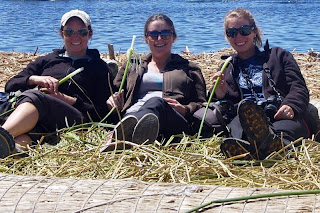
The floating islands, made of reeds.

We then spent a few days in La Paz, Bolivia. The city is built in a stunningly dramatic fashion, cascading down steep mountainsides. It’s all windy hills (that leave you quite winded) and crowded alleyways full of Bolivian women in traditional dress hawking everything from mouse pads to potatoes. It is a decidedly third-world city, but charming in its own, loud way. There are also a surprising number of delicious international restaurants, which we took full advantage of, shockingly. (Bolivian food being the poor-man’s version of Peruvian food and thus not suitable for vacation!) I think we were all surprised at how often we kept comparing Bolivia to Peru, and further surprised by how often Peru won. Absence certainly does make the heart grow fonder.

Enjoying delicious Cuban food in La Paz.

In front of the presidential palace, La Paz. Take that, Evo!

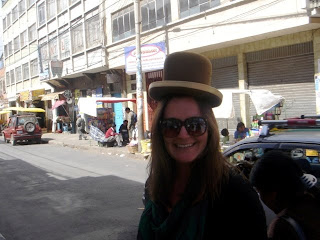
Just like the locals!

However, La Paz came out ahead in the artisanry, or maybe it was just because it was different from what I’ve spent the last two years buying. Either way, we bought lots of souvenirs (mainly for ourselves), ate lots of meals, and hung out with other backpackers in the hostel bar.

A Bolivian alpaca.

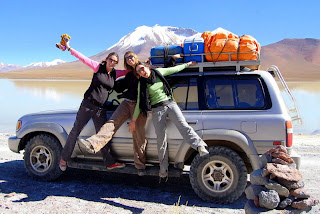
The real adventure of the trip was a three-day tour of southwestern Bolivia, home of the salares (salt flats). My main motivation for the whole trip was seeing these salt flats; the rest was of little concern to me. Luckily, my naiveté paid off and I was floored by the entire trip. Words and pictures will never do the scenery justice … but that won’t stop me from trying!

Ready for anything.

We spent the majority of the first day on and around the salt flats. They were incredible. It’s blindingly white for as far as the eye can see. We were there on the tail-end of rainy season, so some parts of the salares were still underwater, turning them into giant reflecting pools. The best way I can describe it is simply white. Everywhere you looked was bright, bright white. It quite literally took my breath away (though, admittedly that might have had something to do with the altitude) and is like nothing I’ve ever seen before. The big attraction of the salares is the amazing pictures you can take playing around with perspective. We had a little trouble figuring out the ‘trick’, but spent a hilarious couple hours trying our hardest. Eventually we had limited success. While the pictures are a wonderful memento, that view and that experience are what I will hold in my mind’s eye forever. Amazing.

Big ups on the salares of Uyuni, Bolivia.

After the awesomeness of the first day, I was prepared to be underwhelmed by the next two days of sightseeing. How wrong I was! The landscape of this part of the world is absolutely incredible. You’re always at least 4,000 meters above sea level; the clouds, when there are any, look to be within your grasp, and yet the horizon stretches interminably, so you forget you’re on top of the world.

Trippy landscapes.

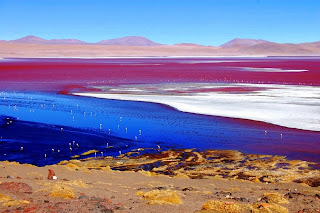
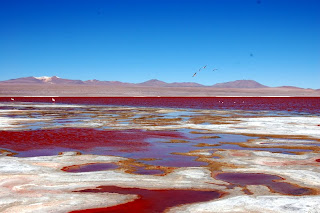
The contradictions confound the senses and it’s hard to make sense of what you’re seeing. The best I can come up with is ‘otherworldly.’ We drove across unending sand dunes, punctuated by crystal clear high-altitude lakes encrusted with bright white mineral deposits. We drove across dried up lakebeds and through a Dali-esque landscape of lava rocks. We bunked down next to a crimson lake (tinted by billions of microorganisms) that was home to hundreds of pink flamingos. And behind it all were towering snow-capped mountain peaks. Every stop afforded another unique and stupefying vista. We saw the sun rise between the sulphuric burps of 5,000 meter-high geysers and watched the sun set over a dusty, remote Andean village. I’m not exaggerating when I say it’s the weirdest, most wonderful place I’ve seen.

The flamingos of Bolivia.

On the Bolivia-Chile border.

We spent a lot of time in cars, buses, and planes to see so many places in such a short amount of time but it was undoubtedly worth it. If you ever find yourself with an invitation to the altiplano of Bolivia, don’t hesitate to check it out for yourself!

Wednesday, March 2, 2011

Upbeat Update

Thanks to all for your kind messages after my "illness" (and if you didn't send me a nice message, here's your chance to make it up to me by sending chocolate. Or peanut butter.). I am feeling much better and my face is back to normal. We (the doctors and I) are placing the blame on mangoes. Apparently I am extremely allergic. The fact that I've eaten several dozen mangoes over the past year doesn't seem to matter. All I know is I'm allergic now and will be staying far, far away from mangoes. Like forever.

So with my face back to its normal size, I was able to take off my sunglasses and mingle with the VIPs at an event at the U.S. ambassador's residence in Lima celebrating Peace Corps' 50th anniversary. It was a great evening. My cocktail party skills were a little rusty and I definitely felt overwhelmed the grandeur and smart, accomplished people. I even got to meet (well, brush shoulders with) Alejandro Toledo, former president and current front-runner in this year's presidential campaign. The current first lady was also in attendance, as were a number of embassy officials and Peruvian government representatives.

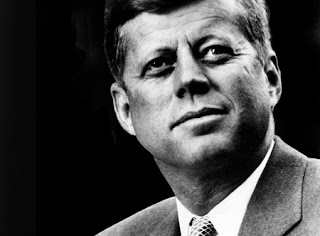
Seeing all these people come together to celebrate and recognize Peace Corps gave me a warm fuzzy feeling all night. It was a wonderful reminder that we are doing important work and it doesn't always go unnoticed. It's also inspiring to think about the thousands of volunteers who have served around the world in the past 50 years, bringing Kennedy's commitment to public service to life in remote towns in far-flung corners of the globe. I am most definitely in good company.

So with a renewed "Yay, Peace Corps!" outlook, I'm looking forward to the next few months. It is hard to believe that this whole crazy experience is quickly coming to an end. I know the next five months are going to fly by and I want to focus on enjoying the present, soaking in all the familiar sights and sounds of Peru, as well as knocking off the last few items on my Peruvian to-do list. Good times ahead!

You still inspire me, sir.